Friday, November 12, 2010

HIV Education Bike Trek continued (written Nov 8)


Kids performing a drama


Kids watching the drama


Video of dancing after the drama


Kevin giving a thank-you speech before heading to the next school


Ready to head out


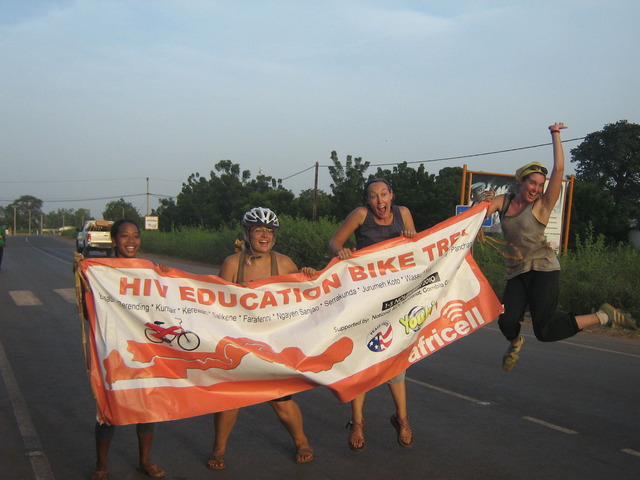
Janjanbureh team posing with our banner before our last day of teaching


Last day...go team!


Kids performing a drama at our last school


Welcoming the Barra team to Farafenni. Nice height Julia!!


Barra team with their banner


Maggie and Lucia presenting at the closing ceremony in Farafenni


The whole group (or most of us at least)

Konkerons!! (written Oct 25)

I think I've mentioned konkerons before, but I'll give a brief explanation of this unique cultural practice again. Konkerons are people dressed up in big furry or leafy costumes that run around screeching and chasing people with machetes. They often use hallucinogens and are believed to have magic powers, such as flying and projecting their voices over long distances. Many people are afraid of them, especially children. This fear is not unfounded, as occasionally they hurt and even kill people. Konkeron are usually associated with circumcision ceremonies, but they crop up at other times as well. I've heard a variety of explanations for the reasons behind the practice, including instilling respect for elders and driving away bad spirits. We recently had a group circumcision ceremony in the compound next to us, so we've had a LOT of konkeron activity lately. I caught one on film the other evening (from the relative safety of our backyard)...see below:

HIV Education Bike Trek (written Nov 8)

Last week I participated in an HIV Education Bike Trek where I went from school to school with seven other volunteers teaching students about HIV/AIDS. The trek actually consisted of around thirty volunteers, plus Gambian supporters, divided into three teams which convened at the end of the week in Farafenni. Our team worked our way from Janjanbureh (MacCarthy Island) to Farafenni, visiting schools along the way. It was really a great experience and it inspired me to start planning a mini bike trek in our region early next year. More to come on that later. I took a ton of pictures, so I'm going to break this into two posts:


Double decker rams on top of a geli on my way to Janjanbureh. Very impressive! This is how you know Tobaski is coming...


Doing my part emptying out a watermelon for carving


Watermelon jack-o-lantern! Chris with her masterpiece.


Getting ready to ride to our first school


And they're off!


Kids welcoming us at our first school


Julia and Abby surrounded by kids


Abby and Sarah M were matchy matchy for the first day of teaching


Julia in action


Kids performing a drama


Kids in class


Sarah M in action


Looking good!


Video of kids welcoming us at another school

A Lightbulb Moment (written October 25)

For quite some time I have been exasperated and even somewhat disgusted by Gambians expectation of receiving "per-diem" or some other form of financial remuneration for attending work-related workshops, trainings, and in-service meetings. These workshops are extremely common and the amount of time and energy that is put into dealing with this financial compensation has always seemed like a collosal waste of time to me. I could not understand why people should expect to receive additional compensation for doing their job on top of their existing salary. Today, however, it all started to make sense.

It turns out that Gambian health workers, as well as many other civil servants, receive very minimal salaries, to the point that it is generally not enough for them and their dependents to live on. For a little perspective, low to mid-level health workers are paid base salaries of 1,500-3,000 dalasis per month (which comes out to roughly $2-3 per day). These people are often the primary "bread winners" for large extended families (15+ people) who are depending on them. Culturally, for a salaried individual, it is absolutely obligatory to support your family in such a fashion, especially if you have family living in poor rural areas. Even in a country with a low cost of living the numbers simply don't add up, and the social and cultural pressure to support one's family is enormous. Therefore, the gaps have to be filled somehow. This is where per-diems come in. These per-diems are often hundreds of dalasis per day, not including food and travel reimbursements, and can be paid out for one day meetings, short trainings, or even month long activities. Teams of health workers typically rotate who is sent to trainings and split the compensation equally among themselves. Even when split several ways this money adds up quickly. This is why the health workers take their per-diems so seriously. It is not greed, it is not an obsession with money, it is a matter of making ends meet for themselves and for their families, which they cannot do without the per-diems. Jacob later used a good analogy when he compared this system to how waiters and waitresses in the US whose salaries are often below minimum wage, and rely on tips to make up the difference.

As my coworker was explaining all this to me, something clicked when I thought about where the money for these per-diems was coming from. It is coming mostly from big international health institutions such as Global Fund, WHO, UNAIDS, etc. They are probably aware that they have line items written into their budgets for workshop per-diems, but I wonder are they aware they are providing for health workers' extended families in a way that is completely financial and has nothing to do with a health project. I don't have the numbers for how many health workers there are in the country or how much money they make from per-diems per year, but I would venture a guess that these contributions by international health institutions contribute in no small way to the country's economy. While that is not necessarily a bad thing, I highly doubt it is the intended use of the funds by provided by those institutions or indirectly by their donors.

This is just one more layer in the complicated web of dependance on aid. This line of thought raises a whole host of other complicated social and financial issues. One big related issue is rural-urban migration, which is severe enough that some rural villages can be almost completely devoid of educated, motivated young men. It's easy to shake your head at those men who fled to the cities, but those men are sending a lot of resources back to the villages to support their extended families there. Their families need money to buy rice, oil, fish, sugar, etc, and cash-paying jobs are few and far between in rural areas, so they are dependent on money flowing in from their urban bread-winners. Of course, not anyone can get a cash-paying job in an urban area, you need to be educated, so that means it is the educated young people, generally men, who are the ones playing that role. It's interesting to see the similarities between this system and the way remittances work on a larger scale.

A couple generations ago, these issues weren't nearly as big a problem because most Gambians were subsistence farmers, and thus ate what they grew, and didn't have such a need for cash. So how did we end up here? Jacob is a much better person to answer that question, so I asked him, and this is what he says:

"Historically every culture existed based on subsistence farming. In many cases, at one point or another, something changed which allowed people in this culture to start specializing in certain money making activities and transition to a cash based economy. For example, early in American history much of the country existed as a subsistence agricultural economy. Many rural families produced the vast majority of what they consumed. Partially, this was because the cost of transportation and difficulties associated with it made it prohibitively difficult to produce farm products for far-away markets. As transportation improved, state government sponsored canals and roads are a good example, it became possible to ship large quantities of produce quickly and cheaply to market. This allowed people to move away from a subsistence life style and start specializing in various methods of production. The problem in The Gambia is by switching from cous, cassava, and sorghum as the staple foods that were capable of feeding the entire population to rice (which has become trendy recently since, rather ironically, it is associated with the West, resulting in the country importing rice from Asia, mainly Vietnam and Thailand, in large quantities) without the accompanying specialization in jobs that inject cash into the economy the country has difficulty providing for all their food needs and most of the available cash gets sucked into purchasing rice and is thus diverted from the investments that would create future economic growth."

It's quite the conundrum, but understanding all various moving pieces of the problem is the first step, right?

Breaking ground (written October 24)

This weekend we finally broke ground on our water project that we have been working on since...well, since we got to site back in January really. Long story short, there is a nearby community that doesn't have acceptable access to safe water, so, after countless meetings with the community, we applied for and were awarded a grant from Peace Corps (a SPA grant, for those of you that that means something to) to extend the piped water system from a nearby semi-urban center to reach this community. Once the project is completed, the community of 600+ people will have 3 new public taps, giving them easy access to safe running water. The community is digging almost 800m of 1m deep trenches by hand in rocky soil, no small feat, especially for a community that is largely lacking men in their prime (a consequence of urban migration). The community also selected a water committee to maintain the system and collect user fees, and we helped them open a savings account at a local bank for the money. Anyways, getting back to the digging, I took some pictures that I thought you all might enjoy:


We had a good showing for the second day of digging. Even the kids came out!


Modou laying down the law on some kids who were slacking off


Working hard


Who's that stud?


Getting hot, but still at it. Note the tool the guy with the white shorts (Alpha) is holding. It's called a sambou and is basically a heavy metal rod with a sharp end. Very good for digging in hard ground.


This old guy worked his tail off all day


...with a pipe, no less! Love it.

Friday, October 22, 2010

Heeding nature's call (written October 10)

A couple random frustrating thoughts about heeding nature's call while living as a Peace Corps Volunteer:

1 - The sun is hot - so hot that if I go outside to use our latrine during the day without shoes on, I need to run back inside put something on my feet, and then return to do my business.

2 - I have to go outside in the first place (but thank you thank you Peace Corps for giving us our own so we don't need to go running out into the compound in the middle of the night)!

3 - Outdoor bathroom. Rainy season. Bad timing. Enough said...

4 - In the rainy season, both your toilet paper and soap need to stay inside your house. Don't forget to take them with you when you go out!

5 - If I go to the bathroom either at dawn or dusk I am liable to end up with mosquito bites in unfortunate places.

6 - Insects live down there. Some of the time they like to come out.

7 - Squatting technique and aiming ability are important skills.

8 - Occasionally people drop important things down there - such as cell phones, sandles, and concrete latrine covers (don't ask I don't know how that volunteer accomplished the task).

9 - There are occasionally small child level eye sized holes in your fence, which take an inordinately long time to repair.

10 - If you are away from home and need to go, you need to distinguish between #1 and #2. If you ask for #1 you will most likely get taken to a concrete slab in someone's backyard. Sort of poses a problem if you all of a sudden decide #2 is going to happen too.

The Violet Shyness of their Eyes

While we were in Kombo last week, I picked up a book at the Peace Corps office entitled "The Violet Shyness of their Eyes: Notes from Nepal" (by Barbara J. Scot, published in 1993). I have read quite a few Peace Corps memoirs, but all of them have been written by people who served in Africa, so I figured it would be interesting to read a volunteer memoir (Scot was taught English for a year in Nepal when she was in her late 40s...she never actually says she was a Peace Corps Volunteer, but it certainly sounds like she was) about a completely different region and culture.

Once I got into the book, however, I was surprised to find that many of the challenges Scot describes sound very familiar. Some of these challenges I knew were common to almost any Peace Corps-type experience (culture shock, wild fluxuations between euphoria one moment and feeling completely helpless and incompetent the next, isolation, constant scrutany, self-reflection, questioning what you are doing there, frustration with gender roles and the treatment of women, etc), but there are others which I naively thought were specific to Africa, or even West Africa. A few examples include, in no particular order: students "learning" by rote memorization in a language they barely understand; the pervasive belief that anything Western is better than anything non-Western; the intense desire of young adults, especially educated ones, to go to the West to "make their fortunes;" a lack of value placed on personal privacy and personal possessions ("in Nepal it is considered selfish not to share"); and the frequent wearing of white clothes in a dusty, dirty environment (and people's mysterious ability to somehow keep their white clothes clean). Very interesting.

Scot also spends quite a bit of time discussing her evolving opinions on the ethics of development, which is something most Peace Corps-type volunteers grapple with at one point or another. I don't agree with everything she says by a long shot (and to be perfectly honest, I actually wouldn't recommend the book at all) but she does raise some important and difficult questions. Here are a few good quotes:

"What do you do as a culturally sensitive development worker when elements of the system you are trying to be sensitive to are basically abhorrent to your own values?...The women in this group make no bones whatsoever about their intentions to enlighten Nepali women to the possibilities of change from their present subordinate status. It seems easy. We're right and they're wrong. But what what if the Nepalis came over to the US and started telling Iowa beef farmers that it was wrong to kill cows. Or what if the Saudi Arabians came and told women in New York that it was wrong for them to drive cars? Is that what is meant by cultural imperialism? A 'culturally sensitive' development worker is beginning to seem like a contradiction in terms."

"Saturday is a bidhaa, a holiday, in Nepal, and little clusters of men gathered lazily under the chautaara, the resting tree, with its gnarly roots. Little boys tossed a ball made from old socks back and forth to each other. The women at the water tap, in their wonderful wildflower shades of clothes, stood talking with their golden water urns glowing in the sun. Four little girls played a complicated jump rope game. Could I honestly say these people's lives would have been improved if they had spent their bidhaa at the mall?"

"So much development aid has been pouring into Nepal - an inundation of mostly good intentions - and much of it has run off like the early spring thundershowers, noisy and colorful, but with little substance. The positive aspects of modernization that will really grow and flourish here will have to come from [Nepalis]. And their society will be so much richer for finding ways to modernize that are compatible with their indigenous traditions."

"Nepal is not 'behind' the West. It's just a different place. And it has much that the West is crying for: stable families that guide children into solid identification with their society as a whole; a spirituality that pervades their daily life; and a blend between work (that's still mostly honest physical labor) and play that validates the importance of enjoying life. We should be studying them to see how we can compensate for what we've lost before they've modernized so much that they have little left to teach."

"I, for one, am not about to give them much advice on women's equality until we have worked things out a little better at home. For just a generation ago, I was taught as surely as any village Nepali girl-child that I was a second-class citizen at best, and that I was not worth very much without a man. I, like them, knew it was my duty to get married and have sons, even though my grandmother talked about preserving family names instead of religious duties to release the father's soul to the next reincarnation."

The issues Scot is getting at in the quotes above are just a few of the many issues we are struggling to come to terms with here. Given that I intend to pursue a career in international public health and development, this ongoing struggle that is absolutely critical both in terms of my personal and professional development. As they say here...it's not easy de!